


For years, we’ve known about the impact of social media on world events. From the Arab Spring to the current Iran War, these events have significantly shaped the course of events in unexpected ways.
But as we get further into the century, social media has shifted from a communication tool to information warfare.
Social media is heavily affected. We know something is happening. But you might not know how this is exactly done:
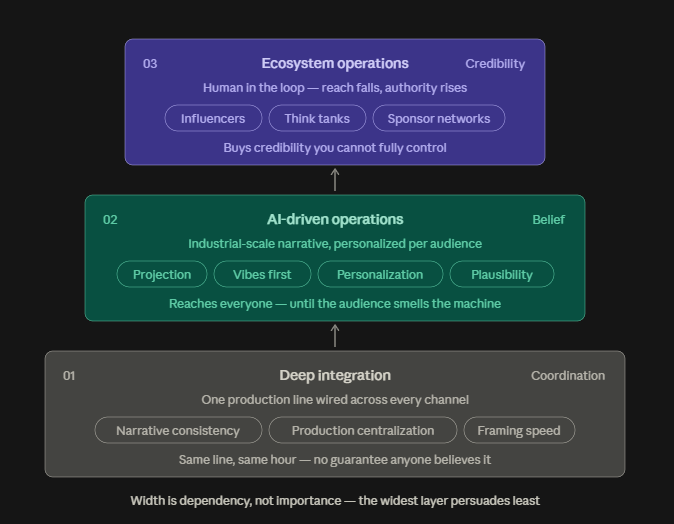
Lots to dig into here. But while technology forms the foundation of information war in the AI age? It doesn’t wholly convince people of your narrative.
Do we know what is true anymore? How are governments using it? And what is the deep strategy that is used to fight an info war?
To answer that, we need to understand what info war means in the 21st century.
The bottom of this article could be cut off in some email clients. Read the full article, unbroken here.
The Shift
At one point, social media was tryly social. You logged on, connected with friends, and made connections across the world. The medium had no strategic purpose, and it had users.
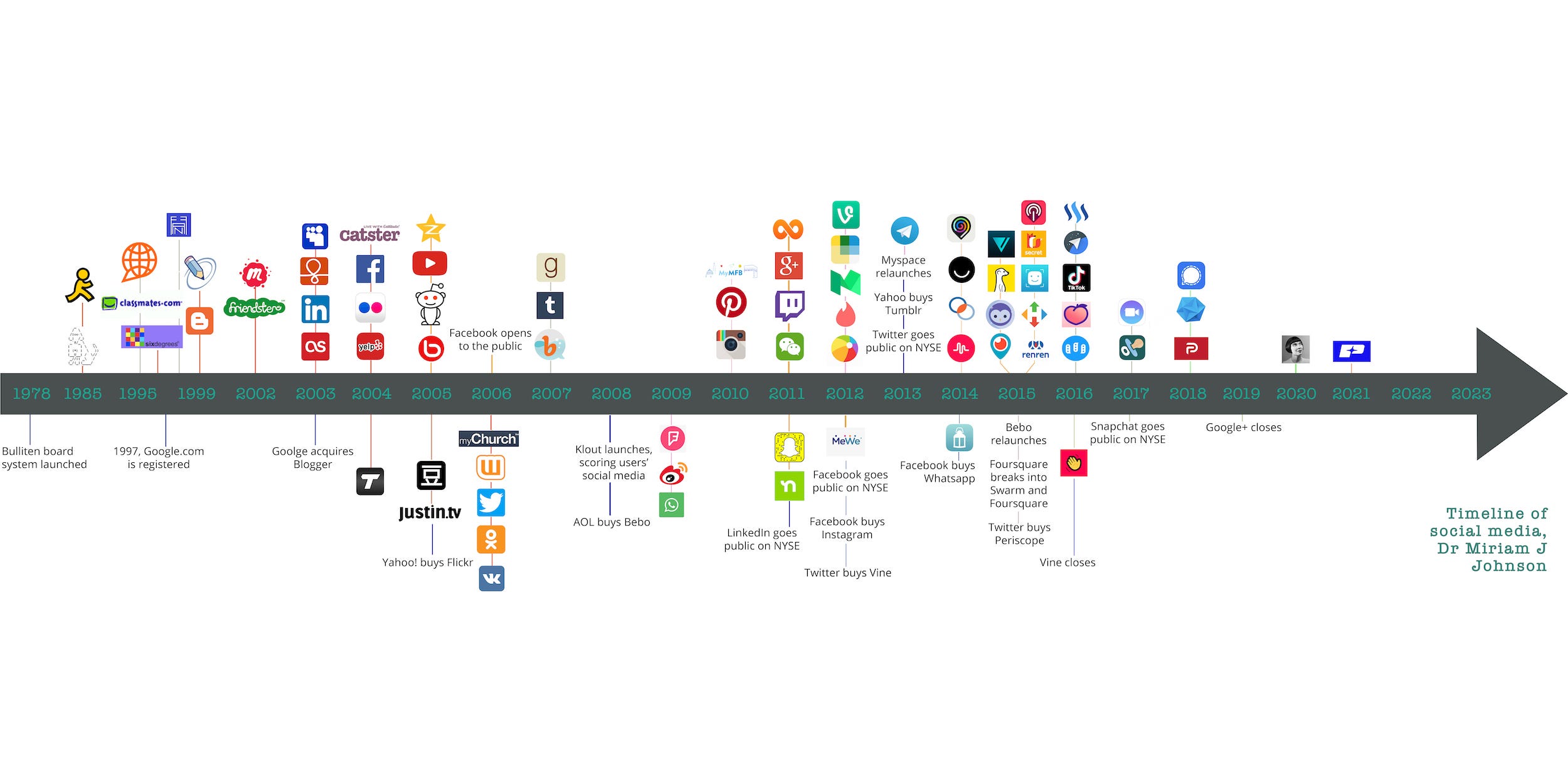
That changed rapidly as social media was adopted and started to influence events. And it’s not an exception. Every communication revolution since the printing press has traced the same pattern:
Amusmement
Enthusiastic techno-utopian predictions
Mass adoption
Commoditization and commercialization
Ideological adoption
Government regulation and co-option
Every communications revolution has followed the same arc, and each time the participants believed they were witnessing liberation. They were witnessing rearmament.
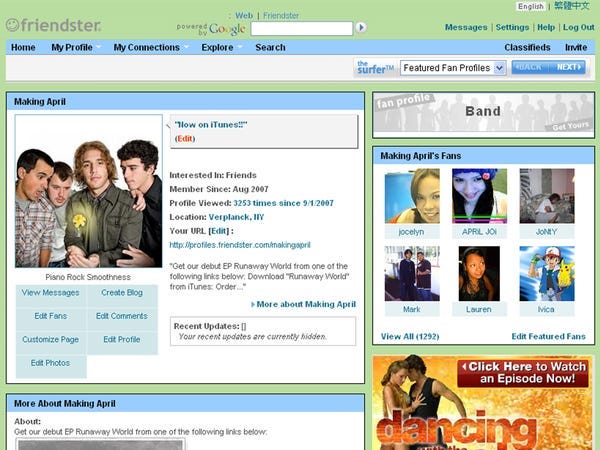
Merchants, for example, adopted the telegraph as a convenience of commerce. By 1914, governments had turned it into the nervous system of mass mobilization. Radio experienced a similar effect in the 1920s and 1930s.

In each case, societies embraced the new technology without any framework of what it would do to them. Then it was pragmatically adopted later by governments that learned the theory from challenges to their monopoly on power.
Social media is now completing this passage. Part of why we are starting to see a dead internet theory become more and more real.
What is different is not that states have learned to manipulate information. But how do they change our perception of it?
How are governments influencing the narrative?
States have manipulated information since civilization began. Pay off an oracle here, exaggerate a bulletin there. But that existed in a time of information asymmetry. Few people were literate. Even when they gained literacy, control of information sat firmly with governments and big media.
But social media changed that asymmetry for the first time in human history:
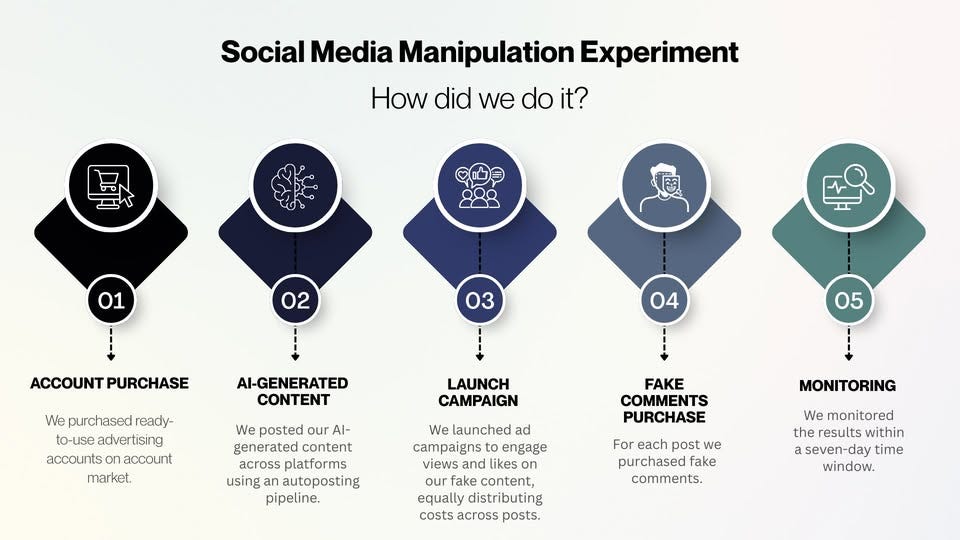
Why? Because it adds an environment that no single nation can rule. Even if a nation controls a social media platform, the volume and variety of data is far too vast.
There’s a shift now that AI and generative AI can mass-produce narratives and truth at an industrial scale, as I said before in a different article:

The volume is far too high now. Even for those who work in the field. Governments are no different. They can no longer ignore false information or block it. Instead, they must maintain narrative initiative at home and abroad.
There are many theories on how to leverage AI to help win the propaganda and information war. But I want to start with the foundation: deep integration.
The Boring Step Everyone Skips
With so many conflicting sources of truth, governments have turned to an old strategy: centralize the source of truth. Or at least multiple versions that benefit it.
This is deep integration. The fusion of technology, platforms, and data management to manage messaging.
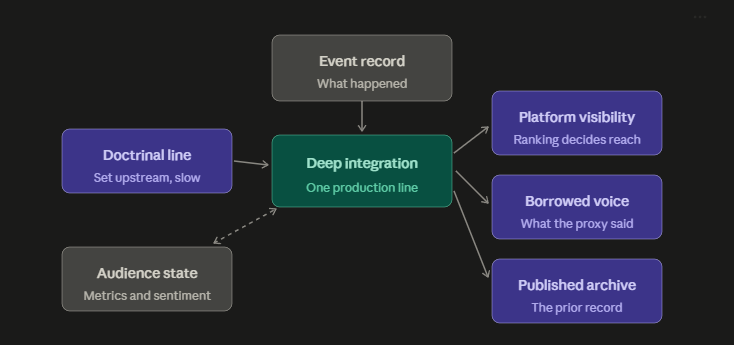
Sounds simple. But logistically, it’s hard.
Nations must not only keep narrative consistency but also merge multiple channels into a single production system. While responding to the extremely fast velocity of social media. This is the part where AI is used the least, but it sets the foundation.
A message repeated across ten channels persuades more than the same message stated once.
What it really does:
Narrative consistency. It’s a myth that a state loses by telling lies. It loses on its own contradictions. An adversary catches you saying two different things in two different places, points at the gap, and lets your audience finish the argument. Deep integration closes the gap before anyone can pry it open.
Production centralization. Owning the production pipeline and the platform controls every message before it exists. I’ve said before that great powers this century need control of at least one platform of their own. They also use this on their rivals’ platforms to disrupt events.
Framing speed. Stories move fast, and you want people locking onto one version while encouraging another to get memory-holed. The trick is to shrink the time between an event and the story you want wrapped around it. A single production line wired for AI frames faster. And when the story turns against you, it reframes faster too.
Coordination is a capability. Belief is a judgment someone else makes. An integrated system guarantees that every channel repeats the same line at the same hour. It guarantees nothing about whether anyone believes it.
So the state can now line up its message across every platform it owns, and across a few it doesn't. You can watch it happen in both directions.
American voices are turning up on Chinese apps like Weibo and Xiaohongshu. Chinese state voices are turning up here on Substack or X.
All of them are posing as independent influencers but are hired by others. And they’re not on X by accident:
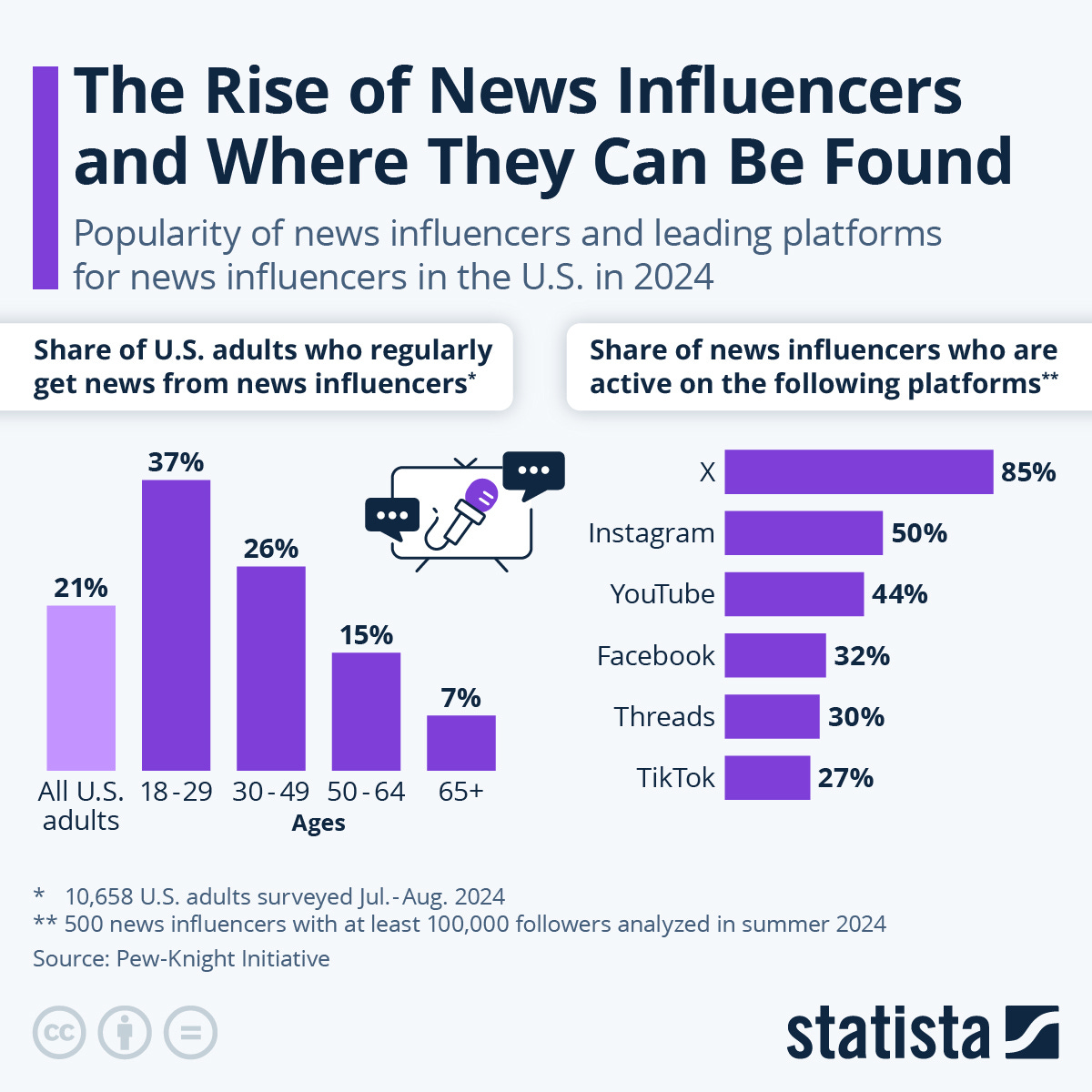
There’s nothing wrong with that, and that’s just the nature of it now.
Blocking or censoring a story is crude. Accelerating one and redirecting another narrative is the real skill. You get it to outrun the negative.
You can’t do either without centralizing production first.
Deep integration can guarantee that every channel says the same thing at the same hour. But it can't guarantee that anyone believes it.
You can build coordination, but belief gets people to buy into your narrative. But how do you do that? And how do you manufacture belief and doubt at scale?
Why Speed Compounds Now
Shaping belief isn’t easy. It requires a digital ecosystem that gives experiences rather than slogans. Call it building a vibe ecosystem, and I’ll go into that a bit more.
While deep integration gets media and government to build something even more important.
This is AI-driven media operations.

You’re probably thinking AI-driven operations = producing deepfakes or making bots sound human. That’s part of it. But what it is about is trying to reach broader and more diverse global and domestic audiences.
You’re not getting rid of the human. But you are algorithmically conditioning them based on:
user behavioral data on websites
responses to LLM chatbots
dynamic recommendation engines that synthesize that data
It’s using g AI directly to accelerate a narrative, seize the initiative, tailor and personalize it in real time, and project it to new audiences. Interesting no?
There are different ways that this is done. But several things I’ve found consistently stick out:
Narrative projection to gain ground. Most people think of narrative control as defense, but offense is more important. With the volume of data important is offense. This extends far beyond censoring sensitive topics. We're talking about subtle guidance on religion, culture, national reputation, and the principles of international relations.
Persuades by vibes first, arguments later. The new approach is a conversation. And they are your tour guide. It's far easier when you give them something to experience and vibe through. Like a digital museum showcasing your cultural and national achievements. You have even more credibility if they can live vicariously through an influencer. Xinhua News Agency launched an AI current-affairs agent called “Xinhua Yudian”, to frame and answer questions about news.
Digital experiences as narrative building. It's easier to create a sympathetic narrative if you give experiences. Virtual experiences and avatars create curated experiences to create narrative experiences. Saudi Arabia did this with a metaverse that let users explore Saudi heritage through avatars.
Regional personalization. Personalization has never been easier. But most people still think of this as translation: take the message, put it in another language, done. That's not personalization. AI-driven ops can create media or interact with groups in their language. Even personalize their message and live stream it with influencer cloning,
Plausibility. The first coherent account of an event sets the terms for every account that follows. Speed is the prize, not reach or accuracy. Responses and creating an experience/frame around this matter. Machine learning can be used to get the temperature and sentiment of emotions and prejudices to screen and target receptive audiences.
What this enables is content manipulation rather tha messaging and censorship. Or at least an agent that is skilled at framing events in ways that benefit your narrative.
China Daily has already moved on the AI-agent front specifically, contracting Tencent Cloud in 2024 to build a communication agent system for automating news production and content review.
Notice that AI operations have several parts:
experiences
two-way communication
cloud platform
personalization
data collection
This is a superpower. Instead of wasting time refuting counter-narratives, you're shaping opinion and narratives, all the while collecting multiple types of user data.
Want more in-depth analysis? Get members-only content for the price of a small coffee per month:
Full-length articles and deep dives
Members-only analysis and How to Learn Strategy.
The entire archive of great politics, power, and strategy thought.
You can keep a captive audience entertained and locked on to a narrative vibe. But even in this case, AI doesn’t replace humans. To get full buy-in to a narrative requires a further and more proactive step…
3. Ecosystem Operations: human in the loop
We instinctively reject obvious AI-generated content or work. But if it plausible or useful to our interests and psychological well-being? We may accept it.
But this depends on the generation.

Gen Z consumers have a more negative sentiment toward AI ads than Millennials, Gen X, or Boomers viewing AI-generated work. What to do in this case?
It’s going back to the source. We still need humans to amplify, respond, and shape messaging. This goes for both countering a narrative and narrative shaping
An ecosystem operation thrives on the social aspect of social media and uses the network effect to spread its narrative. This is the core aspect of seizing and holding initiative in info wars.
Holding the initiative of the attack is harder for governments using AI and social media alone. This means using a human network to amplify the AI message:
Build partnerships with influencers. To get an ordinary person on board with your message, bring influencers. Better yet, create a stable of them to do your bidding. Many have outside contributors for exactly this. Or even let their reporters become influencers, while hiding their connections. Reality is that the borrowed voice is the cheapest and most credible, while state and corporate media have lower returns and less authenticity.
Partner with think tanks and international institutions. Spreading a broader message requires credible institutions. Think tanks buy the one thing influencer partnerships can't: duration. A sponsored post has the shelf life of a news cycle. A citation in a policy brief gets reused for a decade by readers who skip the question of who funded it.
Find the institutional fifth column. There is always some intellectual or NGO somewhere willing to be a mouthpiece. Trying them together and creating a network of international sponsors and advocates, which adds institutional credibility to your AI-driven ecosystem operations. Makes it look less generative and programmatic, and more an appeal to authority.
All of these lend credibility at multiple levels: to ordinary people, the credentialed, and eventually to political institutions. It’s a funnel of sorts:
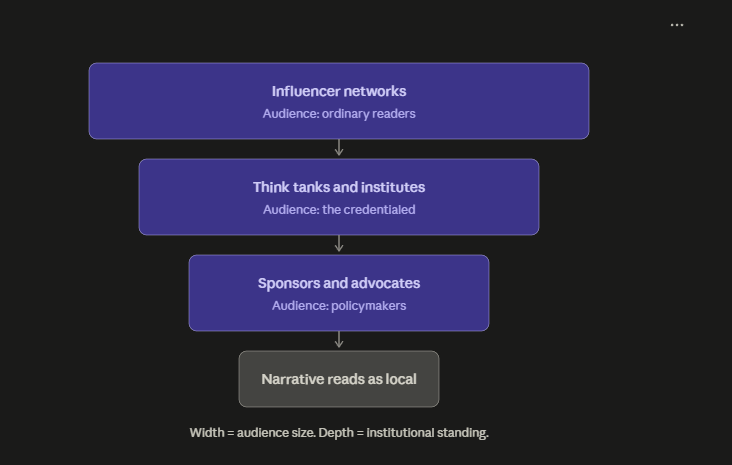
To build a narrative that lasts, it is not enough for it to go viral. Virality lasts until the next exciting dopamine hit. You need to institutionalize your narrative internationally, not just let it go viral.
Core principle of info war:
Start with getting traffic first, then gain narrative initiative while holding narrative ground using institutions.
The influencers gain reach and impressions. AI to industrialize the message, but you need real humans to give it credibility:

What happens in the information space outside a nation is now the core of waging an info war.
Both China and North Korean accounts have made big strides in this, judging by how both are marketing their quality of life hard:
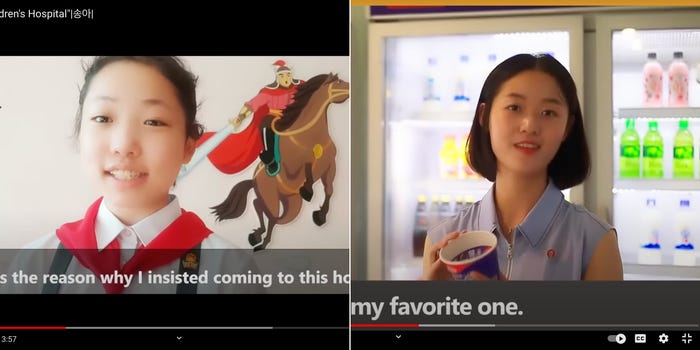
In the past, you created broad mass messages, which People’s Daily, Prvada, or Voice of America used to create a singular message. Now, narrative and info war demands personalized ones. Individuals are served up what appeals to them best, from different accounts.
But the real force multiplier comes from knitting these actors into a coordinated network that can cross-cite, cross-promote, and cross-validate.
It means:
An influencer references a policy brief
The think tank cites the "grassroots" enthusiasm the influencer generated
An international sponsor funds a conference where both appear on stage together.
Each node in the network lends its credibility to the others, creating a hall-of-mirrors effect where the same narrative appears to emerge independently from multiple authoritative sources.
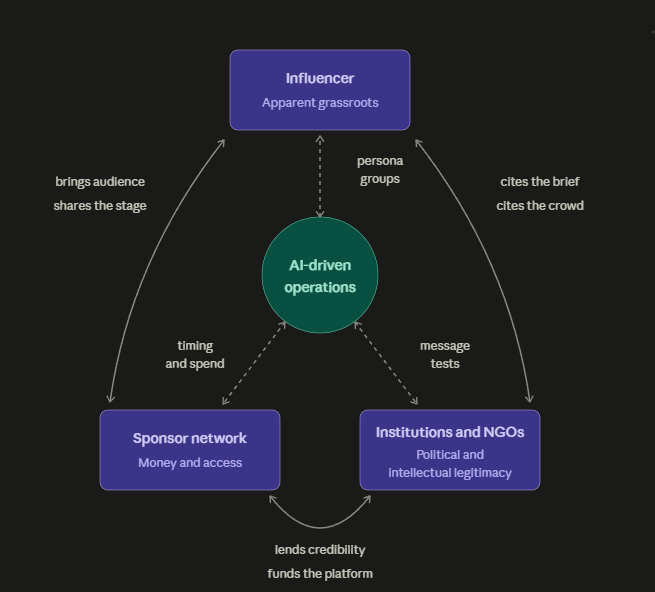
AI-driven operations sit at the center, quietly optimizing who says what, when, and to whom. While mapping persona groups, messaging in real time, and algorithmically and dynamically A/B testing messages. With the help of humans like behavioral psychologists.
This was done several years ago by several major corporations in designing their social media algorithms. Some of which I worked on in my real-life work.
So Is This Good or Bad?
Now that this is happening, should we be worried about how governments are doing influence operations, and fracturing our reality? Here’s some pros and cons I’ve thought of:
Reasons I’m Concerned
Diplomacy runs on a shared description of events. Negotiation needs both parties to agree on what happened. Governments can disagree about what a border incident meant and still make a deal. They can't make a deal when the two publics believe different incidents occurred.
Confirmation bias is rampant. We have a commentary class that performs knowledge and consistently regurgitates facts and slogans. Many great thinkers and commentators have left major social media platforms, going to smaller ones with better culture. Or Discord servers that are echo chambers.
The state ends up reading its own output as evidence. A large share of the accounts producing that engagement belong to the operation. So the ministry reads its own bots and files the result as public opinion.
Speed removes the time leaders need to be wrong in private. The whole point of framing speed is to shrink the gap between an event and the story. That gap is also where officials figure out what actually happened.
Reasons I’m Less Concerned
The adaptation clock has barely started. Narrative and influence operations are as old as time. This is nothing new. But the hard fact is that most of us are unfamiliar with this way of propaganda war. Boomers and Gen X grew up prior to the digital age. Millennials grew up as it matured. While Gen Z was born before GenAI and most social media algos. Counters and frameworks to manage in war will emerge. But Gen AI is only 3 years old, and that’s not enough time to adapt to structural changes at a cultural, societal, or political level. Even responses to the structural benefits and abuses of the Industrial Revolution took 20 years to show.
Cheap signals lose value as they multiply.
Audiences discount whatever costs nothing to make. It happened to the pamphlet, then the radio address, then the cable chyron, then the viral tweet.
Trust moves toward whatever is expensive to fake: someone you’ve met, a local paper with a name on the masthead, an institution with something to lose. You can already see it in how people react to obvious AI output.
Dead internet theory. We have now reached a state were the output of media is so wide, we just want to turn it all off. Some accounts and people have silently left. This may limit the reach of a message, or force it through discredited mouthpieces.
Coordination has a poor conversion rate. Look at the returns. The apparatus produces output you can measure. It hasn't produced policy you can measure. Every channel says the same thing at the same hour and the audience files it under advertising.
Thanks for reading!
As always, thank you, paid subscribers, for supporting The People’s Art of War.
Before then, if you have any questions or comments, feel free to drop them below. I’ll address them in a follow-up piece
And if you haven’t already followed:
Spotify: Statescraft
YouTube: People’s Art of War